
Disney as Text: The Power of Story

How stories can transform learning from a passive to an active experience

Editor's Note: This article is part of Disney as Text, a collection of essays exploring what the principles of Disney Imagineering can teach us about education, creativity, and the design of meaningful experiences. Originally published as part of an earlier series, this essay has been revisited, revised, and expanded to reflect new insights and applications of these ideas. While the original remains available in our archives, this updated edition continues the conversation about how we might reimagine education through the power of story, space, experience, and people.
In the first installment of Disney as Text, I shared a question that began taking shape for me while watching my sons play on Tom Sawyer Island at Walt Disney World: What if we designed schools the way Disney designs its theme parks?
I wasn't suggesting that schools should become amusement parks or that learning needs to compete with entertainment. I was interested in the thinking behind the experience. Disney Imagineers understand that the places they create are more than collections of rides, buildings, technology, and scenery. Every element has a purpose, and in most cases, that purpose begins with a story.
Story gives meaning to the experience.
Think about the attractions you remember most from a Disney park. Chances are, you remember more than the mechanics of the ride. You remember where you were supposed to be, what was happening around you, and perhaps even the role you were invited to play. You weren't simply moving through a building on a ride vehicle. You were escaping from a haunted mansion, flying aboard the Millennium Falcon, sailing through a world of pirates, or joining an expedition into some distant place.
The technology may make those experiences possible, but story gives them meaning.
For educators, there is something important to consider in that distinction.
We Are Wired for Stories
Human beings have always used stories to make sense of the world. Before textbooks, PowerPoints, videos, and learning management systems, people passed knowledge from one generation to the next through stories. Stories preserved history, explained beliefs, communicated values, warned of dangers, celebrated heroes, and helped people understand their place within a larger community.
We still respond to them.
A collection of facts may provide information, but a story gives those facts context. It introduces people, places, conflicts, choices, consequences, and questions. When we care about what is happening, we have a reason to keep paying attention.
Imagineers understand this particularly well. Disneyland was created, in part, as a way to bring stories into the physical world. Stories that audiences had previously encountered on a movie screen could suddenly become places they could walk through and explore. Over time, Disney's parks expanded that idea far beyond the company's animated films, creating original stories and environments in which guests could become participants themselves.
One of the best examples for me has always been the Haunted Mansion.
Entering the Haunted Mansion
The Haunted Mansion creeped me out when I was a kid, and that was exactly what it was designed to do.
The experience begins before you ever board the attraction. As you approach the mansion, the architecture starts establishing the setting. Tombstones appear along the way. Once inside, the environment changes again. The lighting, temperature, sounds, cobwebs, portraits, voices, music, and even the expressions and behavior of the Cast Members contribute to the feeling that you have crossed from the familiar world outside into someplace very different.
As a nine-year-old, I wasn't analyzing any of this. I certainly wasn't thinking about environmental storytelling or sensory design. I just knew there were tombstones outside, dead people were apparently somewhere ahead, the place felt creepy, and the Cast Members weren't doing anything to make me feel better about it.
The story was working.
Legendary Imagineer John Hench wrote extensively about the relationship between what we perceive and how we experience a place. Imagineers recognize that sight, sound, touch, smell, movement, architecture, color, and countless other details can work together to communicate a story without requiring someone to explain it to us.
Walk through a Disney park and you can see examples everywhere. Music changes as you move from one land to another. Architecture establishes time and place. Landscaping helps conceal one environment while revealing another. Props suggest that something happened before you arrived. Even the transition from one area to the next can prepare you for a different chapter of the story.
The more I studied this approach to design, the more I realized that Imagineering was giving me language for things I had discovered intuitively during my years as a classroom teacher.
Every Classroom Tells a Story
A classroom is also an environment, and everything within it communicates something to the people who enter.
During my years as a teacher, I intentionally designed my classroom to feel different from many of the other spaces my students encountered during the school day. I taught in a portable classroom for much of that time, so there certainly wasn't anything remarkable about the architecture. What I could control was what happened inside.
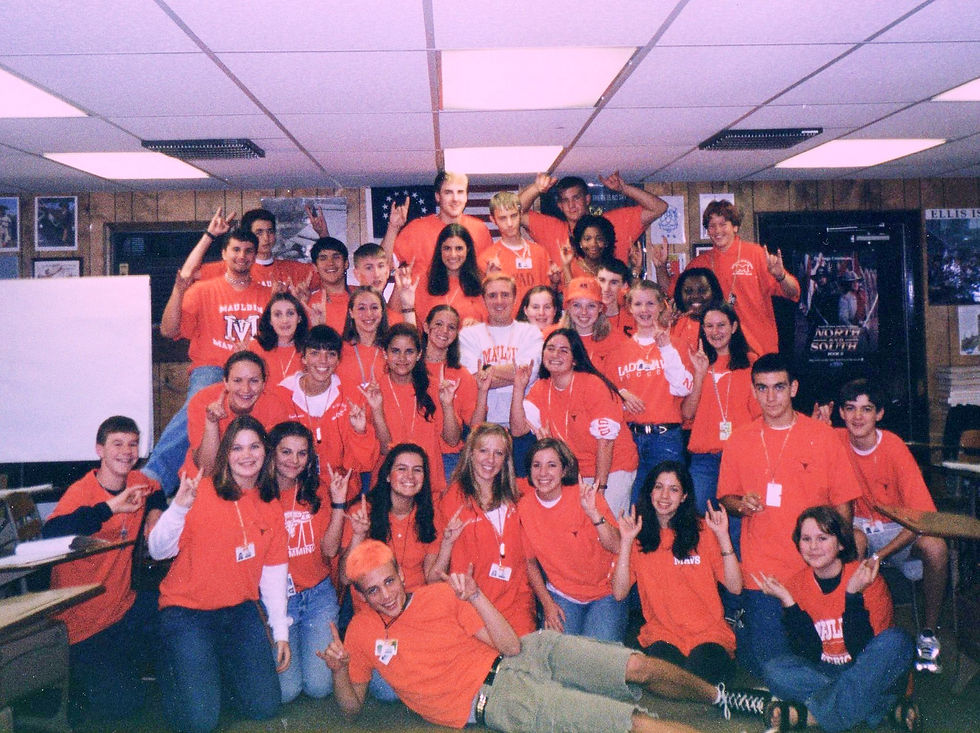
Student artwork covered the walls alongside movie posters, historical images, books, toys, artifacts, and other objects connected to what we were studying. Music was often playing when students entered. Even the apple-cinnamon air freshener I used to cover the unmistakable smell of an aging portable classroom became part of what students associated with the space.
None of those things were there simply as decoration. Together, they helped establish the feeling that this was a place where we were going to explore ideas, make connections, ask questions, and occasionally approach history in ways students might not have expected.
Story became an important part of that approach.
I taught history and mythology using Star Wars and Indiana Jones, not because I wanted to replace historical content with popular culture, but because these familiar stories provided entry points into subjects we were already studying. Star Wars opened doors into conversations about ancient Rome, mythology, political power, the American West, Nazi Germany, and the Hero's Journey. Indiana Jones provided opportunities to explore archaeology, ancient civilizations, historical artifacts, and the complicated ways popular culture shapes our understanding of the past.
Students who might not initially have been interested in a traditional lesson about mythology suddenly had something familiar to hold onto. Once they recognized the connection, we could travel much further.
Over time, however, I came to understand that the greatest potential of story in education goes beyond using a popular movie or character to make a lesson more engaging. The most meaningful stories can help students recognize that they have a place within the story themselves.
When Students Become Part of the Story
I saw this firsthand at a school where I served as principal when we created a two-week crash course in human-centered design called SFCSxDesign. Inspired by the work of Stanford University's d.school and Auburn University's Rural Studio, we challenged students to confront a real problem in our community: homelessness.
Students learned how to interview, empathize, prototype, iterate, collaborate, and develop solutions for real people. Those design skills were important, but the project changed when the issue stopped being abstract.
We invited people who had experienced homelessness to visit our school, along with individuals whose work brought them into direct contact with people experiencing it. Our students listened to their stories, asked questions, and began to understand lives that were far more complicated than the assumptions they may have carried into the project.
Homelessness was no longer simply a topic.
It had names, faces, experiences, frustrations, hopes, and stories.

The students eventually used what they learned to design and construct a 250-square-foot house built largely from shipping pallets as a prototype for transitional housing. As we neared completion, I was working alongside a seventh-grade student named Luca when he stopped and looked at what we were building.
He told me he never imagined that he would be building a house, especially one intended to help someone experiencing homelessness. What amazed him most was that they were kids, and yet they were doing something that felt real and useful.
I have remembered that conversation for years because Luca understood something important in that moment. He wasn't completing an assignment about homelessness. He had become part of a larger story involving people in his own community, and he recognized that he had the ability to contribute something to it.
That is where story becomes especially powerful in education.
What Story Are We Inviting Students Into?
Stories can certainly capture attention. They can make history more interesting, introduce a scientific problem, provide context for a mathematical challenge, or help students connect with literature. But their greatest potential may be in helping students understand why what they are learning has meaning beyond the classroom.
The question for educators, then, isn't simply What story am I telling?
We should also ask, What story am I inviting my students to enter?
There is an important difference.
The first still places the teacher at the center. We tell the story, and students listen.
The second creates the possibility for participation. Students investigate, make choices, solve problems, create something, help someone, or contribute their own ideas. Learning becomes connected to a purpose they can understand because they have a role within it.
Disney Imagineers have understood this for generations. A story becomes more powerful when people are given an opportunity to step inside it. The physical environment, the details, the people, the sensory elements, and the actions we are invited to take all help transform that story into something we experience.
The same principle can shape learning.
A compelling story can open the door, but what happens once students walk through it is where another part of the Imagineering process becomes important. We have to think about the experience we are creating around that story: what students will see and hear, what they will do, how they will interact with others, what choices they will make, and ultimately how the experience will make them feel.
Because a story becomes much more powerful when we are given the opportunity to live some part of it.
In the next installment of Disney as Text, we'll explore the Power of Experience and what Imagineers can teach us about designing learning students don't simply observe, but actually become part of.


Comments